Articles Posted in Work Place injuries

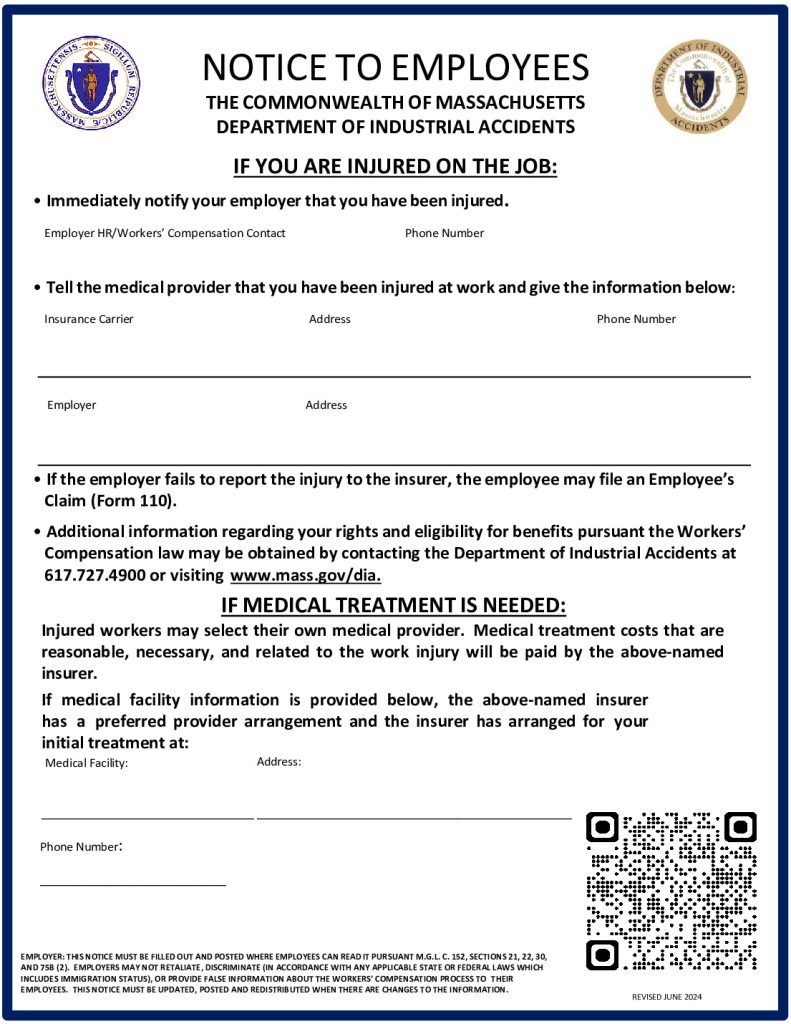
DIA-first-report-of-injury-791x1024

If you were injured at work in Massachusetts and your employer refuses to file an injury report, you are not alone. This situation happens far more often than most people realize. Every week, workers contact our office saying things like:

  • “My boss told me to use my own health insurance.”

  • “HR won’t file the paperwork.”

  • “They don’t believe the injury is serious.”

  • “They told me to take a few sick days instead.”

Here’s the truth:

Under Massachusetts law, your employer must file a First Report of Injury (Form 101) — and if they don’t, you still have the right to receive workers’ comp benefits.

This guide explains exactly what the law requires, why some employers refuse to file the report, and what steps you can take immediately to protect your weekly checks, medical care, and job.

Continue reading

iStock-675941222

When you’ve been injured at work in Massachusetts, one of the biggest concerns is making sure you get the medical treatment you need. Workers’ compensation insurance is designed to cover reasonable and necessary medical treatment related to your injury. But the process isn’t always straightforward—insurance companies often delay or deny approvals, leaving injured workers frustrated.

If you’re wondering how to get your treatment authorized, this guide breaks down the steps and explains what you can do to protect your rights.

Understanding Your Rights to Medical Treatment in Massachusetts

Under Massachusetts workers’ compensation law (M.G.L. c. 152), injured employees are entitled to:

  • Payment of medical bills for treatment that is reasonable, necessary, and related to the work injury.
  • Coverage for doctor visits, surgery, physical therapy, prescriptions, and diagnostic tests.
  • Reimbursement for travel expenses to and from medical appointments.

Continue reading

kin-li-vWqpKioWYmk-unsplash-scaledAt Carney, Rezendes & Crowley, LLC, we’ve represented injured Massachusetts workers for decades — including hundreds of construction workers from Boston, Quincy, Brockton, Fall River, New Bedford, Milton, Braintree, Plymouth, Taunton, and Bridgewater.


If you were hurt while working on a prevailing wage construction site, you may be entitled to substantially higher workers’ compensation benefits than most injured workers realize.

Here’s what you need to know — and how we can help ensure you’re not leaving money on the table.

Walking-Working Surface Safety Regulations

jan-antonin-kolar-QQNQjrKEl6w-unsplash-scaled
Generally, employers are required to keep all walking-working surfaces safe for employees, visitors, and patrons.  There is a specific OSHA (Occupational Safety and Health Administration) regulation which addresses this safety issue:

29 CFR 1910.22(a)(3): Walking-working surfaces are maintained free of hazards such as sharp or protruding objects, loose boards, corrosion, leaks, spills, snow, and ice.

joshua-mancini-6fegAz1Us5U-unsplash-scaledIn the construction industry, there is a general rule of thumb often referred to as the “6-foot rule.”  The “6-foot rule” typically is applied to major commercial construction projects, as well as smaller residential construction projects, amongst others.  Essentially, the 6-foot rule requires employers to implement the use of fall protection when construction workers are working at heights of 6 feet or greater above a lower level.

At the Carney, Rezendes & Crowley, LLC, our attorneys have fought hard and successfully represented injured construction workers who were injured due to a “6-foot rule” safety violation. Recently, Attorneys Jeremy M. Carroll and Brendan G. Carney obtained a jury verdict in the amount of $925,000 for an injured construction worker who fell 10 feet because there was no fall protection.

Continue reading

gettyimages-509557490-612x612-300x200

On October 29, 2020, The Massachusetts Supreme Judicial Court issued its ruling in Mark Mendes’s Case, No. SJC-12857, which held that the Massachusetts Department of Industrial Accidents has subject matter jurisdiction over a claim involving an interstate truck driver based on his employment having “sufficient significant contacts” with Massachusetts.  This opinion expands Massachusetts’ jurisdiction over workers’ compensation claims, where in the past they were limited to circumstances where:

  1. The employee was employed by a Massachusetts employer; or
  2. The employee was injured while working in Massachusetts; or
  3. The employment contract was executed in Massachusetts.

Continue reading

dmitry-demidko-eBWzFKahEaU-unsplash-Money-1-scaled

No. Typically, you do not pay a personal injury or a workers’ compensation attorney out-of-pocket.  At the Carney, Rezendes & Crowley, LLC, we focus on personal injury and workers’ compensation cases which operate on what is called a “contingency” fee.   A “contingency fee” means that we only get paid if we get you compensation, which typically occurs through either a negotiated settlement, mediation, arbitration, or a jury trial verdict.

Why Not?

The reason for a “contingency fee” is to be able to provide legal representation to injured workers and injured people from all levels of income.  If personal injury or workers’ compensation attorneys required clients to pay attorney fees out-of-pocket, only wealthy people would be able to afford an attorney when they are hurt. Injured workers and people from all income levels deserve an attorney to fight for them and to represent them for injuries that never should have occurred. Here at the Carney, Rezendes & Crowley, LLC, we take pride in fighting for injured workers and people who are injured needlessly due to safety violations which occur in construction sites, motor vehicle collisions, and many other types of dangerous situations.

Continue reading

Injured by a Forklift?

crates-and-forklife-1463090-638x479-2

Forklift, or Powered Industrial Truck (“P.I.T.”), injuries are very common in the construction industry for both drivers and nearby workers.  According to the Occupational Safety and Health Administration (OSHA), an estimated 85 deaths result each year as a result of forklift operation accidents, as well as almost 35,000 serious injuries and almost 62,000 non-serious injuries per year.  In the U.S., 1 in every 6 workplace deaths occur in forklift related incidents.

With roughly 856,000 total forklifts in the United States, this means that approximately 1 in 9 forklifts will be involved in an accident that results in injury or death.  Further, the Industrial Truck Association estimates the average use for the life of a forklift or P.I.T. is approximately 8 years.  Taking this factor into consideration, a fair projection calculates that almost 90% of forklifts will be involved in an incident that results in a worker getting injured over the course of the lifetime of the forklift.  At the Carney, Rezendes & Crowley, LLC, we have skilled and dedicated attorneys who are experienced representing people with personal injury and workers’ compensation claims resulting from forklift accidents.

Continue reading

gettyimages-509557490-612x612-300x200

Judge gavel, scales of justice and law books in court

On June 4, 2019, a Middlesex County jury awarded the Plaintiff, Benjamin Roy, a total of $925,000.00, which was reduced by 26% to $684,500.00 for the comparative negligence of Mr. Roy.  With interest, the final judgment amounted to $828,301.18.

On February 5, 2015, Mr. Roy, age 37, was working as a foreman for a framing contractor Shawnlee Construction at the construction of an Avalon apartment complex in Marlborough, MA.  Shawnlee Construction had subcontracted a portion of the framing work to the Defendant Freitas Corporation.  Later in the day, while inspecting the work of the Defendant, Mr. Roy fell through an unguarded opening onto a concrete floor 8-9 feet below, causing him to fracture his right calcaneus (heel bone).  Mr. Roy alleged negligence on the part of Defendant Freitas Corporation, namely that Freitas was responsible for installing guardrails in his work area to protect workers from heights of greater than six feet, per OSHA regulations.  The Defendant denied that he had failed to install guardrails at any time on this construction project.  The evidence presented at trial established that Shawnlee Construction had been having issues with the Defendant adhering to industry safety rules on several prior occasions, including issues with failing to install guardrails in other areas of the construction project.  The Defendant also alleged that Mr. Roy was to blame for his injuries because Mr. Roy was looking up at the ceiling at the time that he walked off the edge of the hole in the floor.  Mr. Roy testified that as part of his job duties, he was responsible for inspecting the work in the ceiling and expected that the Defendant had installed stairs in the hole in which he ultimately fell, and if he hadn’t, that he would have put up a guardrail around the floor opening. Continue reading

If you are injured and it is due in part or in whole to someone else’s negligence, then you may have a personal injury case. Negligence is generally defined as a failure to use reasonable care. If you were hurt because someone else failed to use reasonable care, you may have a personal injury case.

If you were injured while at work you may also have a workers’ compensation case. Workers’ compensation is paid for by your employer’s insurance. The purpose of worker’s compensation is to provide an injured worker with a portion of his or her lost wages and to pay for all reasonable and necessary medical treatment related to the work injury. Personal injury cases differ from workers’ compensation because personal injury cases are intended to compensate you for the full amount of medical expenses, lost wages, as well as pain and suffering

A personal injury case is brought against the person or entity who is fully or partially responsible for causing your injury. Examples of personal injury cases include if you were hurt on a construction site, in a motor vehicle crash, or in a slip and fall injury on a defective walkway or on snow and ice.  Massachusetts’ workers’ compensation laws do not allow an injured worker to bring a personal injury case against their employer or a co-employee.  They are limited to workers’ compensation benefits.  Injured workers may, however, be entitled to workers’ compensation benefits and also have a personal injury case arising out of the same injury if a negligent third party (a person or entity other than the employer of the injured worker) caused or contributed to their injuries.  An example would be a construction worker who is injured while working for a trade contractor, and was injured due to the negligence of the construction project’s general contractor. Continue reading

Justia Lawyer Rating
Contact Information